

Think most budgets fail by the 20th of the month?
Zero-based budgeting for beginners fixes that by giving every dollar a job before the month starts.
It’s simple.
Assign your income to bills, savings, debt, and fun so nothing floats away.
You avoid surprise shortfalls and start hitting goals faster.
Read on to learn a clear, step-by-step way to set up your first zero-based budget tonight and stop wondering where your paycheck disappeared.
Core Explanation of Zero-Based Budgeting

Zero-based budgeting means you give every dollar of your income a job before the month starts. You keep assigning until income minus expenses hits zero on paper. That doesn’t mean your checking account should actually drain to nothing (keep $100 to $300 as a buffer), but every cent gets assigned somewhere. Earn $3,000? Then allocate $3,000 across rent, groceries, savings, debt, fun money, all of it, until there’s nothing left unassigned.
People new to budgeting like this method because it forces a decision about what your money will do instead of leaving you confused about where it went. You’re not giving yourself a free pass to blow everything. You’re giving every dollar a purpose, and that includes purposes like emergency fund, retirement, or knocking down credit card debt. Moving from passive spending to active assignment is what makes zero-based budgeting actually work. Money stops leaking out on stuff you didn’t plan for and can’t remember buying.
This creates financial clarity fast. Know exactly where your money’s going before you spend it, and you cut the chance of overspending or leaning on credit to fill gaps. You also start catching patterns. How much you really drop on takeout. How often random expenses show up. Where you can shift money toward goals that matter. Zero-based budgeting turns your income into something you control, not a mystery that evaporates by the 20th.
How Zero-Based Budgeting Works

Start by figuring out your total monthly income. Paychecks, side gigs, benefits, whatever comes in. Then list every expense you expect that month: rent, utilities, groceries, insurance, debt payments, savings, even small stuff like subscriptions or coffee runs. Assign a dollar amount to each category, tweaking until the math balances so income minus expenses equals zero. Got $200 left after covering bills? Don’t leave it floating. Assign it to something specific, like extra loan payments or padding your emergency fund.
You’ll need to track spending all month. Every time money comes in or goes out, log it and compare to your plan. Overspend in one category? Pull from another to keep the total balanced. At month’s end, repeat the whole thing with a fresh budget for the next month, adjusting for birthdays, car registration, seasonal costs that weren’t part of last month.
The principles that make this work:
- Every dollar gets assigned before the month starts.
- You adjust categories mid-month if spending shifts, keeping total at zero.
- You track every transaction to know if you’re on plan or need to fix something.
- You build a new budget each month to match that month’s unique expenses.
Step-by-Step Guide for Beginners

Starting zero-based budgeting gets easier when you follow a clear sequence. The goal is moving from “I think I know where my money goes” to “I know exactly where every dollar is assigned.”
-
Calculate your total monthly income. Add up every source: paychecks, freelance work, child support, side hustle cash, anything you can count on this month. If income varies, use the lowest amount from recent months as your baseline and adjust later if more shows up.
-
List every expense you expect this month. Start with essentials. Housing, utilities, food, transportation. Then add insurance, debt payments, childcare, subscriptions, fun money, and a miscellaneous category for stuff you always forget. Don’t skip irregular costs like annual fees or quarterly bills. Estimate the yearly total and divide by 12 to set aside a monthly piece.
-
Assign a dollar amount to each category. Write down what you plan to spend in each area. Brand new to budgeting? Track your actual spending for a few months first to get realistic numbers. Guessing too low just sets you up to blow the budget in week two.
-
Subtract total expenses from total income. Positive result means leftover cash. Assign it to your current priority, whether that’s debt payoff, emergency savings, or another goal. Negative result? You’ve planned to spend more than you earn. Cut discretionary stuff (restaurants, entertainment, subscriptions) or find ways to earn more.
-
Track every transaction all month. Log what comes in and what goes out, checking each expense against your plan. This is the step most people skip, and it’s the one that makes the method work or collapse. Overspend on groceries? Pull from another category to rebalance.
-
Adjust categories mid-month if needed. Life happens. Car needs a repair you didn’t budget for? Shift money from a less urgent category. The goal isn’t perfection. It’s intentional reassignment so you always know your plan.
-
Review results at month’s end and build the next budget. Look at what worked, what didn’t, what surprised you. Then create a fresh zero-based budget for the next month before that month starts, accounting for anything unique coming up.
Practical Examples of Zero-Based Budgets

Examples make zero-based budgeting less abstract. Seeing real numbers laid out helps you understand how to match your own income and expenses to the method.
Here’s a sample entry-level monthly budget using the zero-based approach. Every dollar of the $5,000 income gets assigned a purpose, and the balance reaches zero.
| Income Source | Expense Category | Allocation |
|---|---|---|
| Paycheck 1: $2,200 | Housing (rent/mortgage) | $1,250 |
| Paycheck 2: $2,200 | Food (groceries + eating out) | $650 |
| Side hustle: $600 | Utilities (electric, water, internet) | $200 |
| Total Income: $5,000 | Transportation (gas, insurance, car payment) | $300 |
| Insurance (health, life, renters) | $850 | |
| Debt payments (student loan, credit card) | $1,000 | |
| Savings (emergency fund + goals) | $500 | |
| Fun and miscellaneous | $250 | |
| Total Expenses: $5,000 | Balance: $0 |
To adapt this to your own finances, start by plugging in your real income and your actual fixed costs. Rent, loan minimums, insurance premiums. Then estimate variable categories like food and transportation based on a few months of tracking. If your numbers don’t balance, cut discretionary spending or reallocate from lower-priority goals until income minus expenses equals zero. The categories stay flexible month to month. Adjust for upcoming irregular expenses like holiday gifts or a dentist visit, and reassign any leftover dollars to whatever matters most right now.
Benefits of Zero-Based Budgeting

Zero-based budgeting increases awareness of your cash flow in a way most other methods don’t. When you’re forced to assign every dollar before the month starts, you see exactly how much room you have (or don’t have) for wants versus needs. That clarity helps reduce the chance of spending money you thought you had but actually didn’t. It keeps savings and debt payoff from being afterthoughts. They get line items just like rent and groceries.
The method also builds the habit of intentional money decisions. Instead of reacting to bills as they arrive or swiping a card and hoping it clears, you’re planning ahead and adjusting as you go. That control makes it easier to weather irregular expenses, prioritize goals, and actually follow through on financial plans instead of abandoning them halfway through the month.
Major benefits:
Every dollar has a clear purpose. Nothing slips through the cracks or disappears into “I don’t know where it went.”
Reduced overspending. When a category hits its limit, you know immediately and can adjust before damage is done.
Explicit space for savings and debt payoff. They’re built into the plan, not leftovers you hope to find at month’s end.
Monthly adaptability. You can shift priorities and categories to match what’s happening in your life right now.
Increased financial confidence. Knowing your plan and tracking progress reduces money stress and decision fatigue.
Challenges and Limitations

Zero-based budgeting takes more time and discipline than simpler methods. You’re not just setting a few categories and checking in once a month. You’re tracking every transaction, adjusting mid-month, and building a new plan every 30 days. That level of detail works well for people who want control, but it can feel overwhelming if you’re already stretched thin or if numbers stress you out.
The method also struggles with irregular income and variable expenses unless you plan for them carefully. Freelancers, commission earners, hourly workers whose schedules shift can find it hard to assign every dollar when they don’t know exactly what’s coming in. Seasonal or annual costs (gifts, travel, car registration) can blow up a monthly budget if you didn’t divide the yearly total and set aside a piece each month. And if life throws you a curveball, like an emergency repair or a surprise medical bill, the rigid structure can make you feel like you failed even when you handled it responsibly.
Typical limitations beginners face:
High time commitment. Logging every transaction and reconciling categories takes consistent effort.
Difficulty with unpredictable income. Hard to zero out a budget when you don’t know next month’s paycheck.
Frustration when reality doesn’t match the plan. Overspending one category means cutting another, which feels restrictive.
Learning curve for irregular expenses. Forgetting to budget for annual costs leads to month-end scrambles and discouragement.
Common Mistakes and How to Avoid Them
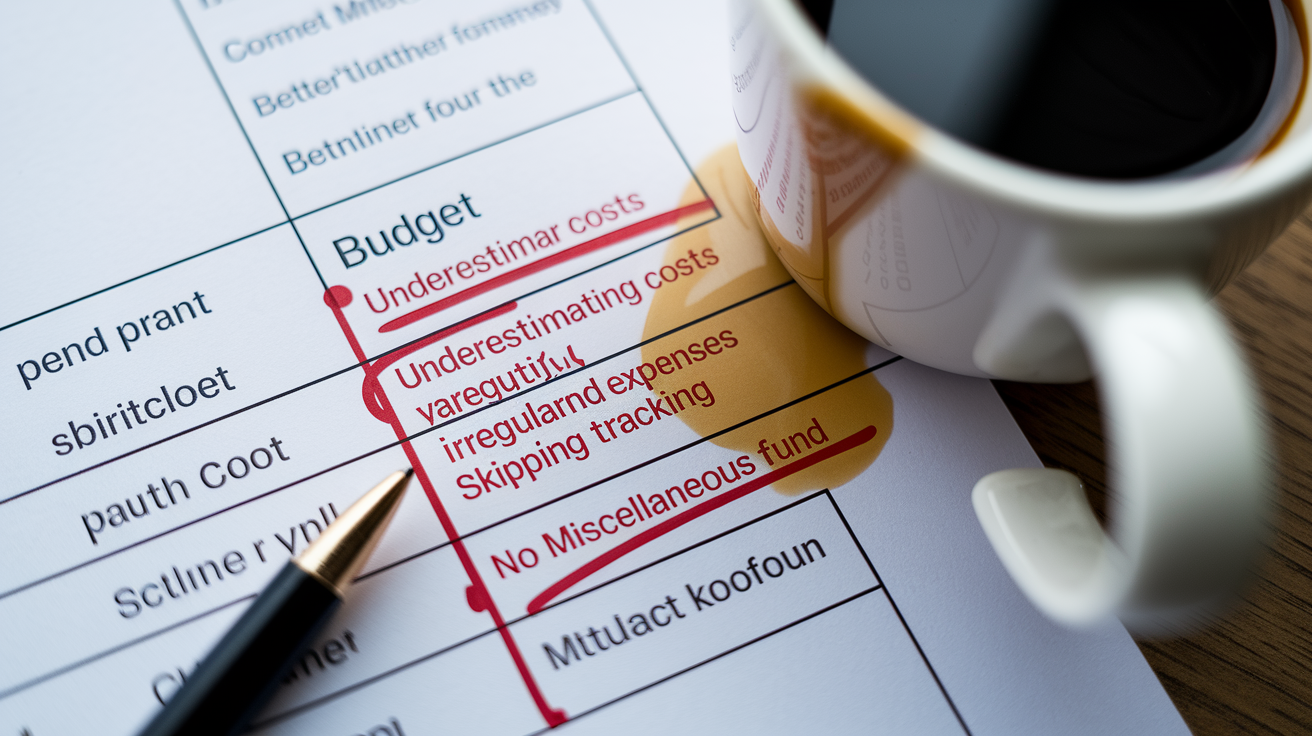
New zero-based budgeters often underestimate how much they spend in variable categories like groceries or gas. They set an optimistic number, blow past it by mid-month, and then feel like the whole system failed. The fix? Track actual spending for at least two or three months before locking in category amounts. Real data beats wishful thinking.
Another frequent mistake is forgetting irregular or seasonal expenses. People budget for monthly rent and utilities but skip things like birthday gifts, annual subscriptions, oil changes, holiday travel. When those costs hit, they either break the budget or pull from savings in a panic. The solution is to estimate the yearly cost, divide by 12, and set aside that amount every month in a separate “irregular expenses” fund. Treat it like any other line item.
Not tracking expenses consistently. Without a log of every transaction, you’re guessing whether you’re on plan. Avoid this by choosing one simple tracking method (app, spreadsheet, notebook) and using it every single day.
Failing to adjust mid-month. Zero-based budgeting isn’t set-and-forget. Overspend in one category? Pull from another immediately to keep the balance at zero. Waiting until month’s end means you’ve already lost control.
Skipping the miscellaneous category. There’s always something small you forget. A parking fee, a last-minute errand, a pack of gum. Add a $50 to $100 miscellaneous line so these don’t wreck your plan.
Setting unrealistic allocations. If you’ve never spent less than $600 on food, don’t budget $400 and hope willpower saves you. Start with honest numbers and trim gradually once you see where the waste actually is.
Trying to budget irregular income without a buffer first. If your paychecks vary, save up one full month of income as a cushion, then budget using last month’s earnings for this month’s expenses. Skipping the buffer leaves you short when a low-income month hits.
Recommended Tools and Templates

You don’t need fancy software to start zero-based budgeting, but the right tool makes tracking and adjusting faster. Spreadsheets work well if you like customizing categories and formulas. Set up columns for income, planned spending, actual spending, and the difference, then update daily or weekly. Budgeting apps automate a lot of the math and can link to your bank to import transactions, though free versions usually require manual entry. Printable templates are good for people who think better on paper and want a physical record they can mark up and review.
The best tool is the one you’ll actually use every day. Apps feel like extra work? A simple notebook and calculator will do the job. Hate manual data entry? Pick an app that syncs with your accounts and cuts down friction. Start with one method for a full month, then switch if it’s not sticking.
Common tool and template options:
Basic spreadsheet templates. Free, customizable, works offline, and lets you track multiple months on one file.
Budgeting apps with zero-based features. Many offer free versions with manual entry and premium tiers that auto-sync your bank and flag overspending.
Printable monthly worksheets. Physical templates you fill out by hand, useful for people who process information better on paper.
Budget calculators. Online tools that help you quickly allocate percentages and see if your plan balances before committing.
Expense checklists. Pre-built lists of 50+ common monthly expenses so you don’t forget categories when setting up your first budget.
Final Words
Get started by assigning every dollar a job: we explained what zero-based budgeting is and why it helps beginners take control.
Then we walked through how it works, a seven-step setup, real examples, plus benefits and common traps to avoid. We also listed tools and templates so you don’t have to build the spreadsheet from scratch.
Use this post as a checklist while you try zero-based budgeting for beginners, adjust as you go, document receipts, and review mid-month. Small changes add up. You’ll be calmer and more in charge of your money.
FAQ
Q: How to start zero-based budgeting?
A: To start zero-based budgeting, list your monthly income, assign every dollar a job (bills, needs, wants, savings, debt), adjust categories until the balance is zero, then track spending daily.
Q: What are common ZBB mistakes?
A: Common zero-based budgeting mistakes include forgetting categories, making unrealistic allocations, skipping mid-month adjustments, inconsistent tracking, and treating the plan as rigid. Avoid them with realistic estimates and weekly check-ins.
Q: How to save $10,000 in 3 months?
A: To save $10,000 in 3 months, plan to set aside about $3,350 per month, cut nonessentials, pick up temporary extra work, pause recurring wants, and auto-transfer every saved dollar to savings.
Q: What is the 50 30 20 rule vs zero-based budgeting?
A: The 50/30/20 rule divides income into needs 50%, wants 30%, and savings/debt 20%. Zero-based budgeting assigns every dollar a purpose until the budget equals zero, so it’s more hands-on and exact.