

Think shopping is your therapy? It’s costing you money and calm.
Emotional buys start small but stack up—late-night carts, comfort meals after a rough meeting, that “treat” you grab to feel better.
This post hands you a clear six-step plan that replaces willpower with simple systems: delays, friction, and quick coping moves.
You’ll learn to spot triggers, build pause rules, and try cheap alternatives so most urges disappear before you hit checkout.
Start here for step-by-step actions you can use today.
A Structured Action Plan to Reduce Emotional Spending Behaviors

Emotional spending is what happens when you buy stuff to numb or dodge negative feelings instead of dealing with what’s actually wrong. The trigger could be a rough day at work, boredom, loneliness, stress, or something as random as a bad hair day. Online shopping and same-day delivery have turned this into a real financial problem, especially when tiny purchases stack up to hundreds or thousands every month.
A structured plan works because it swaps willpower for systems. You’re not white-knuckling your way through every urge. You’re building barriers, delays, and backup responses that cut off the impulse before it becomes a transaction. The point is changing how you behave, not beating yourself up for having feelings.
Here’s the full six-step plan you can start using today.
Track every discretionary purchase for 30 days and write down the emotion and event that happened right before you bought it. That’s how you identify your top three spending triggers.
Create pause mechanisms. Wait 24 hours for anything under fifty bucks. Wait 48 hours for anything over fifty.
Add friction to buying. Delete saved cards from shopping apps. Remove digital wallets. Turn on card-lock features in your bank app.
Pick a weekly buy-day where you only purchase discretionary stuff on one set day per week. Everything else has to wait.
Track emotional purchases in a simple spreadsheet or notebook. Date, emotion, trigger, item, price.
Make a list of coping alternatives. A ten-minute walk, a fifteen-minute call, ten deep breaths. Try one before you check out.
Identifying Emotional Spending Triggers

You can’t change what you don’t see. Open your bank app or pull up your credit card statements and look at the last two months. Go line by line and ask yourself: “What was I feeling right before I bought this?” You’ll start spotting clusters. Three takeout orders all happened after stressful meetings. Late-night online carts show up when you’re lonely or bored. One woman tracked her purchases and saw “row after row” of small charges following the same emotional loop.
Naming the feeling breaks the automatic reaction. When you can say “I’m anxious about tomorrow’s presentation” instead of “I deserve a treat,” you give yourself a second to choose differently. Save a simple feelings chart on your phone. Next time you’re about to make an unplanned purchase, open the chart and name what you’re feeling first. You might still buy it, but you’ve added a moment of awareness that didn’t exist before.
| Trigger | Example Behavior | Notes |
|---|---|---|
| Bad workday or feeling loss of control | Order takeout three times in one week | Food delivery becomes mood repair |
| Boredom or idle time | Browse shopping sites “just looking” and end up buying | Window shopping turns into real spending |
| Anxiety about the future | Buy small “treats” to feel in control now | Spending provides temporary certainty |
| Loneliness or sadness | Late-night online orders for items you don’t need | Shopping fills time and creates anticipation |
| Frustration or being stuck on a task | Impulse-buy something unrelated to “reset” mood | Purchase becomes a mental escape route |
Creating Pause Mechanisms to Reduce Emotional Spending
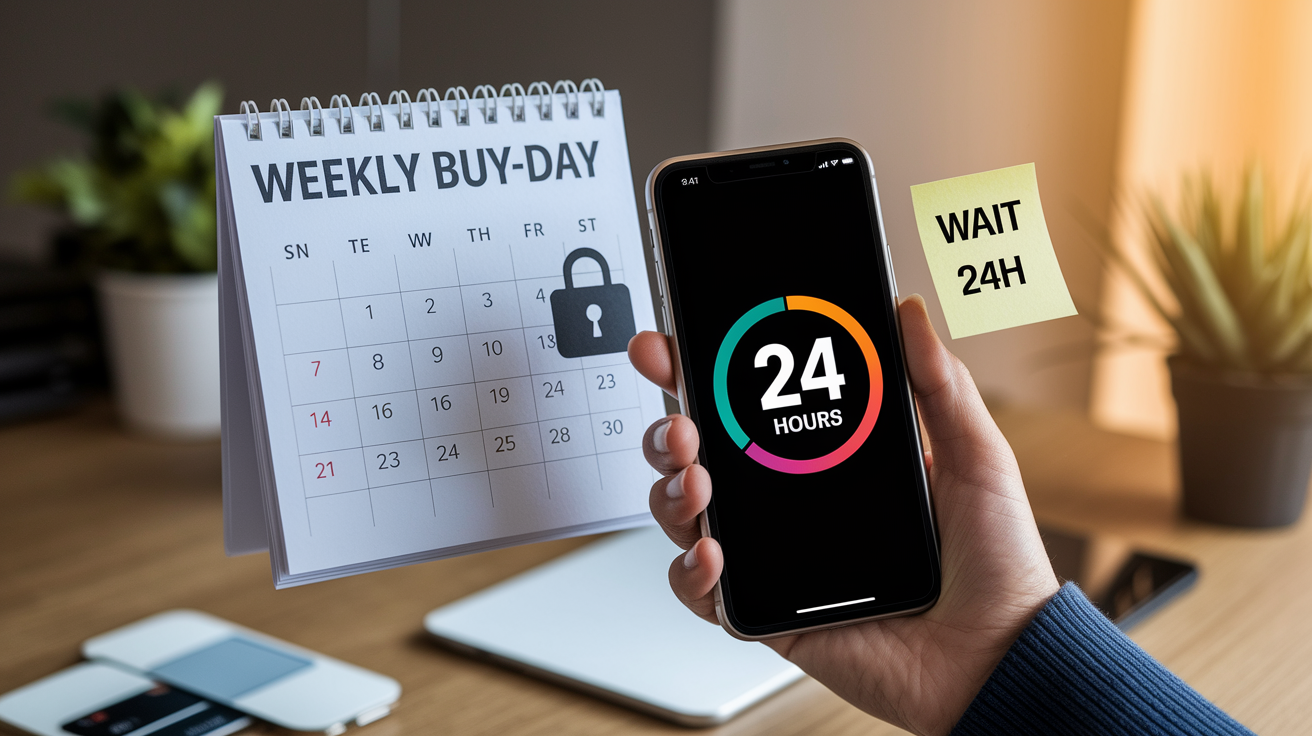
Strong emotional urges fade fast. If you can delay a purchase by even 24 hours, most of the time the need disappears. Pause mechanisms work because they force time between the feeling and the transaction, giving your rational brain a chance to catch up.
Use a simple rule: wait 24 hours for anything under fifty dollars and wait 48 hours for anything fifty dollars or higher. When you feel the urge, add it to a wish list or leave it in your cart, then set a timer on your phone. If you still want it when the timer goes off, the purchase is more likely to be intentional. One person saved six bucks on vegan cheese by waiting until her weekly buy-day on Friday and realizing by then that she didn’t actually need it.
Here are four techniques you can start using right now.
The 24-hour rule. For purchases under fifty dollars, walk away and revisit tomorrow. Set a calendar reminder to check back.
The 48-hour rule. For purchases fifty dollars and up, wait two full days. Most impulse energy will be gone by then.
Weekly buy-day. Pick one day per week (Friday works for a lot of people) to make all non-emergency discretionary purchases. If you want something on Tuesday, write it down and wait until Friday.
Three-question pause checklist. Before checkout, ask yourself: “Do I need this? Will I use it more than four times? Can I afford it in my weekly discretionary budget?”
Building Healthy Coping Strategies Instead of Shopping

Shopping works as a coping strategy because it’s easy, instant, and creates a small dopamine hit. But it only masks the feeling. It doesn’t solve what’s underneath. To break the cycle, you need a list of alternative responses that are just as easy and available as pulling out your phone to buy something.
Create a short list of six to ten quick alternatives and keep it visible on your phone or taped to your wall. Commit to trying at least one for ten minutes whenever the urge to shop hits. Most of the time, ten minutes is enough to reduce the intensity. If the urge is still there after ten minutes, you can reconsider, but you’ve given yourself a fair shot at choosing something else.
Here are eight coping alternatives that work for different emotional triggers.
Take a ten-minute walk outside, even if it’s just around the block.
Call or text a friend for fifteen minutes of conversation.
Spend twenty minutes on a hobby you already own supplies for. Drawing, reading, a puzzle, playing an instrument.
Do ten deep breaths or a ten-minute guided breathing exercise.
Journal for ten minutes about what you’re actually feeling and why.
Prepare a low-cost comfort snack under three dollars that you already have at home.
Do a quick household task like folding laundry or washing dishes to create a sense of completion.
Stretch or do five minutes of simple movement to reset your body.
Budgeting Systems That Prevent Emotional Spending

Budget systems create structural limits that reduce the number of decisions you have to make under stress. Instead of asking “Should I buy this?” every time, the system answers for you: “You have twenty-five dollars left this week. If you buy this, you’re done until Friday.”
One method that works is setting a weekly discretionary budget based on your income and goals. Examples range from twenty-five dollars per week for tight budgets to one hundred dollars for higher earners who want flexibility. Put that amount on a prepaid debit card or in a cash envelope at the start of the week. Once it’s gone, it’s gone. You’re not punishing yourself. You’re giving yourself clear boundaries.
You can also protect savings by opening a separate savings account without an ATM card. Transfer money there automatically every payday so it’s off-limits for impulse purchases. Use your bank’s card-lock feature to block transactions on your debit or credit card when you’re feeling vulnerable. You have to manually unlock the card to spend, which adds just enough friction to stop reflex purchases. When you do save money by skipping an impulse buy, reallocate it intentionally. For example, put fifty percent toward your emergency fund and fifty percent toward a planned reward or goal.
| Budget Method | How It Works | When to Use It |
|---|---|---|
| Weekly cash envelope | Withdraw your discretionary budget in cash each week; when it’s gone, stop spending | Best for people who overspend on cards or apps |
| Prepaid debit card | Load your weekly allowance onto a prepaid card; use only that card for fun purchases | Good for online shoppers who need digital access |
| Separate savings account without ATM card | Move savings to an account you can’t access instantly; no card, no quick withdrawals | Protects long-term savings from impulse raids |
| Card-lock feature via banking app | Lock your debit or credit card in the app; unlock only when you’ve decided to buy | Adds friction for people who shop on saved cards |
Tracking and Reviewing Emotional Purchases

You can’t measure progress without data. Tracking turns vague guilt into specific, actionable patterns. For thirty days, write down every discretionary purchase along with the emotion you felt right before you bought it. Use a simple spreadsheet or notebook with these columns: date, time, emotion, trigger event, item, price, and necessity score from one to five.
At the end of thirty days, review the data. Look for your top three triggers. You’ll probably find that sixty percent or more of your impulse purchases come from just three emotional states. That clarity tells you exactly where to focus your energy. If bad workdays account for ninety dollars in takeout every month, you know you need a specific plan for that trigger.
Here are five steps to track and review emotional purchases effectively.
Set up a simple tracking template with columns for date, time, emotion, trigger, item, price, necessity score (one to five), and whether you tried an alternative first.
Log every discretionary purchase in real time for thirty days, even if it’s just three dollars. Small purchases add up and reveal patterns.
At the end of week one, review your top emotions and triggers and write down your observations. Don’t judge yourself. Just notice.
At the end of thirty days, calculate your total impulse spending and identify which three triggers caused the most dollars spent.
Set a reduction target for month two such as twenty-five percent fewer impulse purchases or fifty dollars less total spending, and compare your results at the end of the next thirty days.
Accountability Practices That Sustain a Step-by-Step Reduction Plan

Accountability turns a private struggle into a shared commitment. When you know someone else will ask “How did this week go?” you’re more likely to follow through. You don’t need a financial coach or therapist. A friend, partner, or even an online community can provide the structure.
Set up a weekly ten to fifteen-minute check-in where you share a simple summary: total discretionary spending this week, number of impulse purchases, top triggers, and what alternatives you tried. If you prefer solo accountability, schedule a weekly money meeting with yourself. Review the same data, write it down, and set one small goal for the coming week. Small rewards also help. For every fourteen consecutive days you stay under your discretionary limit, allow yourself a modest planned treat like ten dollars toward something you’ve been wanting.
Here are four accountability tools that make the plan sustainable.
Weekly accountability partner check-in. Share your spending summary with one person every week for ten to fifteen minutes. Be honest about wins and slip-ups.
Public or written commitment. Write down your plan and your weekly discretionary limit, then post it somewhere visible or share it in a group. Public commitments increase follow-through.
Automated savings for unused discretionary funds. If you have money left in your weekly envelope or prepaid card, automatically transfer it to savings at the end of the week as a reward for staying on track.
Micro-rewards system. For every fourteen days under your limit, give yourself a small planned reward (ten dollars, a favorite meal, an hour of guilt-free leisure). Celebrate progress without sabotaging it.
Final Words
Start by choosing one strong trigger and try the 24-hour rule today. Name the feeling, remove a saved card, and pause before buying.
This post gave you a six-step, action-first path: identify triggers, create pause mechanisms, add friction, use a weekly buy-day, track purchases for 30 days, and build healthy alternatives. It also covered budgeting systems and simple accountability checks.
Use this step-by-step plan to reduce emotional spending and review progress weekly. Small wins add up, and you’ll feel steadier fast.
FAQ
Q: What is a step-by-step plan to reduce emotional spending?
A: The step-by-step plan to reduce emotional spending is a six-step sequence: identify triggers, create pause mechanisms, add friction, use a weekly buy-day, track purchases for 30 days, and build coping alternatives.
Q: How do I identify my emotional spending triggers?
A: To identify your emotional spending triggers, track feelings before purchases with a feelings chart, review past receipts, log purchases for 30 days, and name the top three triggers causing most impulse buys.
Q: How do I track emotional purchases for 30 days?
A: To track emotional purchases for 30 days, record date, time, emotion, trigger, item, price, and a 1–5 necessity score daily, review weekly, and highlight patterns to target first.
Q: What is a pause mechanism and which rules work best?
A: A pause mechanism delays purchases to cool emotions: use a 24-hour rule for under $50, 48 hours for over $50, add a short pause checklist, or consolidate buys to a weekly buy-day.
Q: What is a weekly buy-day and how should I use it?
A: A weekly buy-day means delaying discretionary buys until one set day each week, like Friday. It reduces impulse spending, lets you compare wants, and prevents small purchases from piling up.
Q: How do I add friction to stop impulse buys?
A: To add friction, remove saved cards from sites, delete shopping apps, enable card-locks, or switch to cash envelopes. Making purchases slightly harder cuts the impulse-to-buy reaction fast.
Q: What are healthy coping alternatives to shopping?
A: Healthy coping alternatives to shopping include walking, calling a friend, journaling, trying a 20-minute hobby, deep breathing, or making a low-cost snack under $3—try one for at least ten minutes.
Q: How should I budget to prevent emotional spending?
A: To budget against emotional spending, set a weekly discretionary limit, use cash envelopes or a separate savings account without a card, automate savings, and split saved impulse money between emergency savings and rewards.
Q: How do I measure progress and set targets?
A: To measure progress, track impulse transactions month to month. Aim for about a 25% reduction after one month and roughly 50% by month three, then adjust rules or tactics if needed.
Q: How can accountability help and what tools work?
A: Accountability helps by keeping you honest: schedule 10–15 minute weekly check-ins with a partner or yourself, share brief summaries, use automated transfers, and reward two-week streaks.
Q: What should I do after an emotional spending slip-up?
A: After a slip-up, review the trigger, log the purchase, forgive yourself, tighten pause rules or add friction, and plan a small corrective step like reallocating the money to savings.