

What if your wallet isn’t the problem – your brain is?
Most impulse buys happen in under three seconds, when habit and emotion run the show.
This short guide gives five mindset exercises that actually work: a rapid awareness pause, mapping your triggers, reframing spending thoughts, simple emotional regulation, and a daily visualization practice.
Use these steps right before you tap, click, or walk to the checkout and you’ll stop the tiny buys that add up into real months of regret.
Rapid Awareness Exercise to Interrupt Overspending Habits

Your brain makes purchase decisions in under three seconds when it’s on autopilot. That’s your window. It’s where habit, emotion, and marketing take over before rational thinking gets a vote.
A quick awareness check forces your prefrontal cortex back online. It gives you a chance to evaluate instead of just react.
This 3-minute pause works because it interrupts the loop between “I want it” and “I bought it.” Simple as that.
Here’s what you do:
-
Stop moving. Put your phone down if you’re browsing online. Step back from the shelf if you’re in a store.
-
Name the urge. Say it out loud or in your head. “I want to buy this sweater.”
-
Ask yourself three questions: “What just triggered this?” “What am I feeling right now?” “Do I actually need this in the next 48 hours?”
-
Rate it, 1 to 10. If it’s under a 7, you’re probably responding to emotion or environment, not an actual need.
-
Wait 10 minutes. Walk around. Browse something else. Add it to a list and come back later.
Use this every time you’re about to swipe or click “buy now.” It’s three minutes. But it breaks the autopilot pattern that leads to cart regret and statement shock. Over time, the pause becomes automatic. You’ll catch yourself before the urge even builds.
Mapping Psychological Spending Triggers

Most overspending isn’t random. It follows patterns. And you can see them if you track what’s happening.
A trigger is the situation, feeling, or cue that sets off the urge to spend. Once you know your triggers, you can plan around them instead of reacting every time.
Emotional triggers are stress, boredom, sadness, excitement. They account for a huge chunk of impulse buys. Environmental triggers include sale emails, Instagram ads, walking past a favorite store, or just being exhausted at the end of a long day. Social triggers show up when friends suggest going out, when you see someone post a new purchase, or when you feel like you’re falling behind.
Here’s how to map your triggers over one week. Keep a small notebook or use your phone. Every time you feel an urge to spend, whether or not you follow through, write down the day, time, what you wanted to buy, what you were doing right before, and how you felt.
At the end of the week, look for patterns. You’ll probably see the same handful of triggers over and over.
Common ones:
- Stress. Shopping becomes a release valve.
- Boredom. Buying stuff fills time or creates stimulation.
- Loneliness. Retail therapy feels like comfort or connection.
- Comparison. Seeing others’ purchases makes you feel left out.
- Fatigue. Decision fatigue kills impulse control.
- Digital cues. Notifications, ads, influencer posts.
Once you’ve identified your top three, you can design workarounds. If stress is your trigger, build in a 10-minute walk or breathing exercise before you let yourself browse. If it’s digital cues, turn off sale notifications. Unfollow accounts that make you want to buy.
Mapping doesn’t stop overspending on its own. But it gives you the data you need to interrupt it.
Cognitive Reframing for Purchase Urges

Your thoughts about money create the emotional pressure that drives spending. If you believe “This sale is too good to pass up” or “I worked hard, so I deserve this,” those thoughts feel like facts. They’re not. They’re interpretations.
Cognitive reframing helps you recognize distorted thinking and replace it with grounded reasoning that reduces urgency.
Identifying Distorted Spending Thoughts
Distorted thoughts are automatic beliefs that sound convincing but don’t hold up under scrutiny. “I’ll regret it if I don’t buy this now” is a classic. So is “Everyone else has one, so I should too.” These create artificial scarcity or justify purchases based on emotion instead of need.
Other common distortions include all-or-nothing thinking (“If I can’t buy the expensive version, there’s no point”), catastrophizing (“If I don’t get this, I’ll miss out forever”), and emotional reasoning (“I feel like I need it, so I must need it”).
Once you start noticing these patterns in real time, they lose some of their power.
Reframing Template
When you catch a distorted thought, run it through this three-line reframe:
Line 1: Write down the original thought exactly as it appeared. Example: “This sale ends tonight, and I’ll never find this price again.”
Line 2: Challenge it with one question. Example: “Is that actually true? Have I seen similar sales before?”
Line 3: Replace it with a more accurate statement. Example: “Sales happen regularly. If I miss this one, another deal will come around.”
The reframe doesn’t have to be perfect. It just has to break the emotional urgency long enough for you to make a clearer choice.
Practice this daily for two weeks, even on small purchases. You’ll start catching distortions before they trigger spending.
Reframing works because it separates the thought from the action. You’re not ignoring the urge. You’re just testing whether the thought driving it is reliable. Most of the time, it isn’t.
Emotional Regulation Techniques to Reduce Impulse Spending
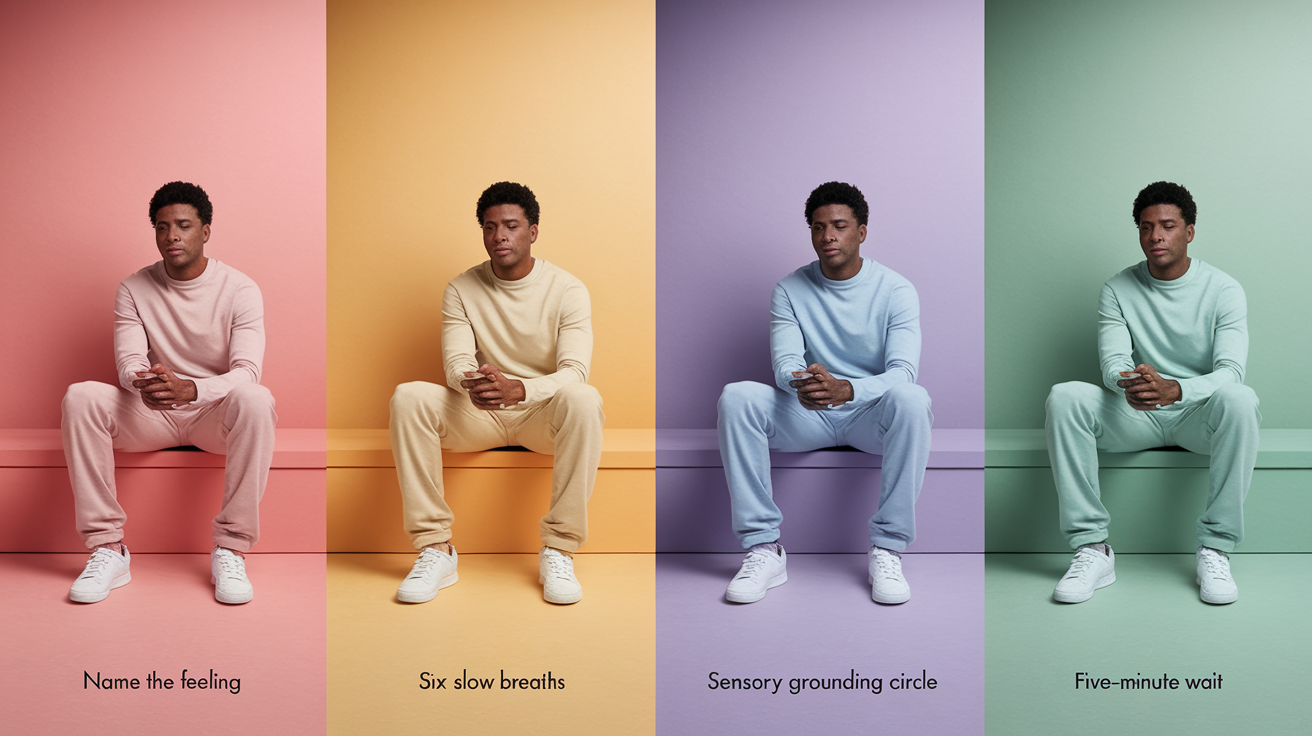
Spending urges spike when your nervous system is running hot. Stress, excitement, frustration. Even positive emotions like celebration can push you into impulsive buying.
If you can bring your emotional intensity down before making a purchase decision, the urgency fades. Clearer thinking takes over.
Emotional escalation hijacks decision-making. When you’re flooded with cortisol or dopamine, your brain prioritizes immediate relief over long-term goals. That’s why you buy things you later regret, then wonder what you were thinking.
The answer is simple. You weren’t thinking. You were reacting.
A quick emotional regulation routine can interrupt that. Here’s a four-step process you can use anywhere:
-
Name the feeling. Say it out loud or write it down. “I’m feeling anxious and I want to buy something to calm down.”
-
Take six slow breaths. Inhale for four counts, hold for four, exhale for six. This signals your nervous system to downshift.
-
Ground yourself with a sensory check. Notice five things you can see, four you can hear, three you can touch, two you can smell, one you can taste. This pulls you out of emotional reactivity and into the present moment.
-
Wait five minutes. Set a timer. If the urge is still strong after five minutes, reassess with the rapid awareness exercise.
This works because it gives your prefrontal cortex time to come back online. Emotional spending happens in seconds. Regulation buys you the time to choose instead of react.
Use it before every non-essential purchase, especially when you notice your heart rate is up or your thoughts are racing.
Shifting From Scarcity Thinking to Sustainable Abundance

Scarcity thinking sounds like this: “There’s never enough.” “I better grab it now before it’s gone.” “If I don’t spend on this, I’m missing out.”
It drives fear-based purchases. Creates a cycle where you’re always chasing the next thing to feel secure. The irony? Scarcity thinking produces the exact outcome it’s afraid of. Running out of money.
Abundance thinking isn’t about pretending you have unlimited resources. It’s about recognizing that you have enough to meet your needs and make intentional choices with what’s left.
It replaces urgency with patience, comparison with clarity, impulse with alignment. When you operate from abundance, you spend less because you’re not compensating for a feeling of lack.
Here’s a thought replacement exercise. Every time you catch yourself in a scarcity-driven thought, write it down. Then rewrite it from an abundance perspective.
“I can’t afford to miss this sale” becomes “I can wait and still find what I need when the time is right.”
“Everyone else is buying this” becomes “I have what I need, and I can choose what aligns with my goals.”
Practice this daily for 30 days. The repetition rewires the automatic belief system that’s been running your spending.
Abundance reduces overspending because it removes the emotional charge. You stop buying things to prove you’re okay or to keep up with others. You start buying things because they serve a purpose you’ve chosen.
That shift alone can cut discretionary spending by 30 to 50 percent within a few months. You’re no longer making purchases to manage emotions or fill a perceived gap.
Visualization Practice for Financial Discipline

Visualization strengthens the part of your brain that values future outcomes over immediate rewards. When you can clearly picture the long-term satisfaction of hitting a savings goal or being debt-free, the short-term dopamine hit of an impulse buy loses some of its appeal.
Here’s a 5-minute guided visualization you can do once a day, ideally in the morning before you check your phone:
Close your eyes and picture yourself six months from now. You’ve stuck to your spending plan. What does your bank account look like? How does it feel to open that statement and see progress?
Imagine a specific purchase you’ve been tempted to make. Now imagine walking past it, saying no, and redirecting that money into savings. Picture the savings balance going up by that exact amount.
Visualize a future version of yourself who no longer struggles with overspending. What habits does that person have? What do they do when they feel an urge to spend? How do they talk to themselves about money?
Picture one financial goal you’re working toward. A vacation, an emergency fund, paying off debt. See yourself reaching that goal. Notice the relief, pride, and freedom that comes with it.
Now bring your attention back to today. Remind yourself that every small choice you make either moves you toward that future or away from it. The decision is always in the present moment.
Run through this visualization every morning for 21 days. It takes about five minutes. The repetition builds a mental image that competes with the instant-gratification pull of impulse purchases.
Over time, your brain starts to prefer the visualized outcome over the short-term reward. That preference shows up in your actual spending choices.
Daily Practice Templates to Reinforce New Spending Habits

Changing your money mindset isn’t a one-time event. It’s a daily practice.
The exercises in this article work when you use them consistently. The easiest way to build consistency is to use simple templates that take less than 10 minutes a day.
A daily reflection template helps you track what’s working and what needs adjustment. A pre-purchase check template gives you a reusable decision filter you can apply every time you’re about to spend.
Both automate the thinking process so you’re not reinventing the wheel each day.
| Template Name | Purpose | Daily Time Required |
|---|---|---|
| Daily Reflection | Review spending urges, emotions, and decisions from the past 24 hours; note one win and one area to improve. | 5 minutes |
| Pre-Purchase Check | Answer three questions before buying anything non-essential: “Why do I want this?” “Will I still value this in 30 days?” “Does this align with my current financial goal?” | 2–3 minutes per purchase |
Use the daily reflection template at the end of each day. Write down any moment you felt an urge to spend, what triggered it, and whether you followed through. If you resisted the urge, note what helped. If you didn’t, note what you’d do differently next time.
The goal isn’t perfection. It’s pattern recognition. After two weeks, you’ll see which strategies work for you and which need tweaking.
The pre-purchase check works best if you write it on a card and keep it in your wallet or save it as a note on your phone. Pull it out before every discretionary purchase. Answer all three questions honestly.
If you can’t give a clear “yes” to all three, wait 24 hours before buying. Most of the time, the urge will pass. When it doesn’t, you’ll know the purchase is intentional, not impulsive.
Final Words
Start using the 3-minute awareness check before any purchase. It snaps you out of autopilot – then map your triggers, reframe that “I deserve this” thought, and use a quick breathing pause to calm the urge.
Add visualization and the daily templates to make change stick. Each section gives a simple step you can do in under five minutes.
Do these money mindset exercises to stop overspending. Small, repeatable moves add up fast, and you’ll feel more control and less stress.
FAQ
Q: What is the $27.40 rule?
A: The $27.40 rule is a personal spending cutoff some people use: purchases above $27.40 get a pause and budget check, while smaller buys are allowed as a quick impulse-control heuristic.
Q: How do I train myself to stop spending money?
A: To train yourself to stop spending, set a cooling-off period (like 24 hours), track triggers, remove saved payment info, follow a simple budget, and use a 3-minute awareness check before buying.
Q: What is the 3 6 9 rule of money?
A: The 3 6 9 rule of money is a basic emergency-fund guideline: aim for three months’ expenses for basics, six months for job risk, and nine months for a larger safety buffer.
Q: Is overspending an ADHD response?
A: Overspending can be an ADHD response because ADHD often reduces impulse control and boosts reward-seeking; many with ADHD report impulsive purchases, though not every overspend means someone has ADHD.