

Think “comprehensive” and “collision” mean the same thing?
They don’t, and that confusion can cost you hundreds.
Collision pays when your car hits something or rolls over, while comprehensive covers theft, weather, vandalism, and animal strikes.
This quick guide shows the practical difference, how deductibles change your out-of-pocket cost, and simple rules for keeping or dropping each coverage.
Read on to pick the option that protects your wallet and your vehicle.
Clear Comparison of Comprehensive vs Collision Insurance Coverage

Collision insurance pays to fix or replace your car after you hit another vehicle, smack into something like a guardrail or pole, or roll over. It covers crashes you cause, crashes where the other driver’s at fault but has no insurance, and solo accidents. Back into a concrete pillar at the mall? Sideswipe a mailbox? Collision steps in. It won’t cover injuries to people or damage to someone else’s property. That’s what liability does.
Comprehensive insurance covers damage that didn’t come from a collision. Theft, vandalism, fire, flood, hail, falling branches, deer strikes, busted windshields. Someone slashes your tires overnight or a hailstorm dents your hood? Comprehensive pays for repairs. People call these “acts of nature” or “acts of other people,” but the coverage stops the moment your car hits another vehicle or object while you’re driving.
Both require you to pick a deductible. That’s the chunk you pay out of pocket before the insurer covers the rest. Common amounts are $250, $500, and $1,000. The deductible comes out of every claim payout. Repairs cost $4,000 and your deductible is $1,000? The insurer sends you $3,000. Car’s totaled and worth $8,000? You get $7,000 after a $1,000 deductible.
| Collision | Comprehensive |
|---|---|
| Triggered by hitting another vehicle or object, or rollover | Triggered by non-collision events (theft, fire, weather, vandalism, animals) |
| Example: rear-end crash, hit a pole, single-car rollover | Example: stolen car, hail damage, tree limb falls on hood, deer strike |
| Typical deductible $250–$1,000 | Typical deductible $250–$1,000 |
| Required by most lenders and lessors | Required by most lenders and lessors |
| Average annual cost: $300–$700 | Average annual cost: $100–$300 |
| Claims usually raise premiums | Weather/theft claims often have smaller rate impact |
In‑Depth Look at Collision Insurance Coverage

Collision insurance kicks in the second your car makes contact with another vehicle, a stationary object, or rolls over. You could be at fault or not. Collision still covers your repair or replacement costs up to what your car’s actually worth. This is different from liability coverage, which pays for the other driver’s car and injuries when you’re responsible. Collision protects your own vehicle in almost any crash where there’s impact.
Five of the most common collision claim types:
- Rear-ending someone at a stoplight or in traffic
- Getting rear-ended when your collision policy is the fastest way to get repairs done (before the other driver’s insurer processes everything)
- Hitting a guardrail, concrete barrier, or highway median after losing control
- Backing into a pole, shopping cart corral, or parked car
- Single-vehicle rollover on a curve or after swerving to avoid something
Your deductible gets subtracted from the repair bill or the vehicle’s value if it’s totaled. Repairs run $5,500 and your collision deductible is $500? You pay $500, the insurer covers $5,000. Filing a collision claim, especially when you’re at fault, usually raises your premium at renewal. How much varies by state, insurer, and how many claims you’ve filed recently. But collision claims generally create bigger surcharges than comprehensive ones because they tell the insurer you’re a higher driving risk.
In‑Depth Look at Comprehensive Insurance Coverage

Comprehensive insurance handles the unpredictable stuff that has nothing to do with how you drive. Thieves steal your car from the driveway. Someone keys the doors. A hailstorm pelts the roof with golf ball sized ice. A tree limb snaps in a windstorm and crashes through your back window. All comprehensive, not collision, because you didn’t hit anything. The damage came to you.
Animal strikes are one of the most frequent comprehensive claims. Hit a deer on a rural highway and your bumper, hood, and windshield could rack up thousands in damage. Fire and flooding count too. Car catches fire in your garage or floodwaters swamp the engine during a storm? Comprehensive pays to repair or replace it, minus your deductible.
Four common events comprehensive typically covers:
- Theft of the entire vehicle or parts (wheels, catalytic converter, stereo)
- Vandalism damage (keyed paint, slashed tires, broken windows)
- Weather events (hail dents, flood damage, lightning strike, tornado debris)
- Falling or flying objects (tree branches, rocks kicked up by another vehicle, garage door that crushes the roof)
Claim payouts follow the same deductible math. Car’s stolen and its actual cash value is $12,000? A $1,000 deductible means you receive $11,000. Hail damage costs $2,400 to fix with a $500 deductible? You get $1,900. Windshield cracks and chips usually fall under comprehensive. Some policies include a separate glass endorsement with a $0 deductible for windshield only repairs.
Comprehensive claims tied to weather, theft, or animals generally impact your premium less than at-fault collision claims. Insurers view these as bad luck rather than risky driving. Glass only claims sometimes carry no surcharge at all, depending on the insurer and state rules.
Deductibles and How They Affect Comprehensive vs Collision Claims

When you buy collision or comprehensive coverage, you pick a deductible amount for each. The three most common choices are $250, $500, and $1,000. Some insurers offer $100 or $2,000 deductibles. Glass coverage occasionally comes with a separate $0 deductible. The deductible is what you pay first. The insurer pays everything above that amount, up to the repair cost or the vehicle’s actual cash value if it’s totaled.
Higher deductibles cut your premium. Moving from a $500 deductible to $1,000 typically reduces your collision and comprehensive premiums by 10 to 30 percent. Depends on the insurer, your driving record, and where you live. That lower monthly bill comes with the tradeoff that you’ll pay more out of pocket if you file a claim. If you rarely file claims and have emergency savings to cover a $1,000 hit, a higher deductible usually saves money over time.
Three claim scenarios showing how the deductible gets subtracted:
- Minor fender bender: Repair cost $1,200, collision deductible $500. You pay $500, insurer pays $700.
- Hail damage: Repair cost $3,800, comprehensive deductible $1,000. You pay $1,000, insurer pays $2,800.
- Total loss after theft: Car’s actual cash value $9,500, comprehensive deductible $1,000. You receive $8,500 (no repair, just the payout minus deductible).
Real‑World Scenarios Showing When Each Coverage Applies
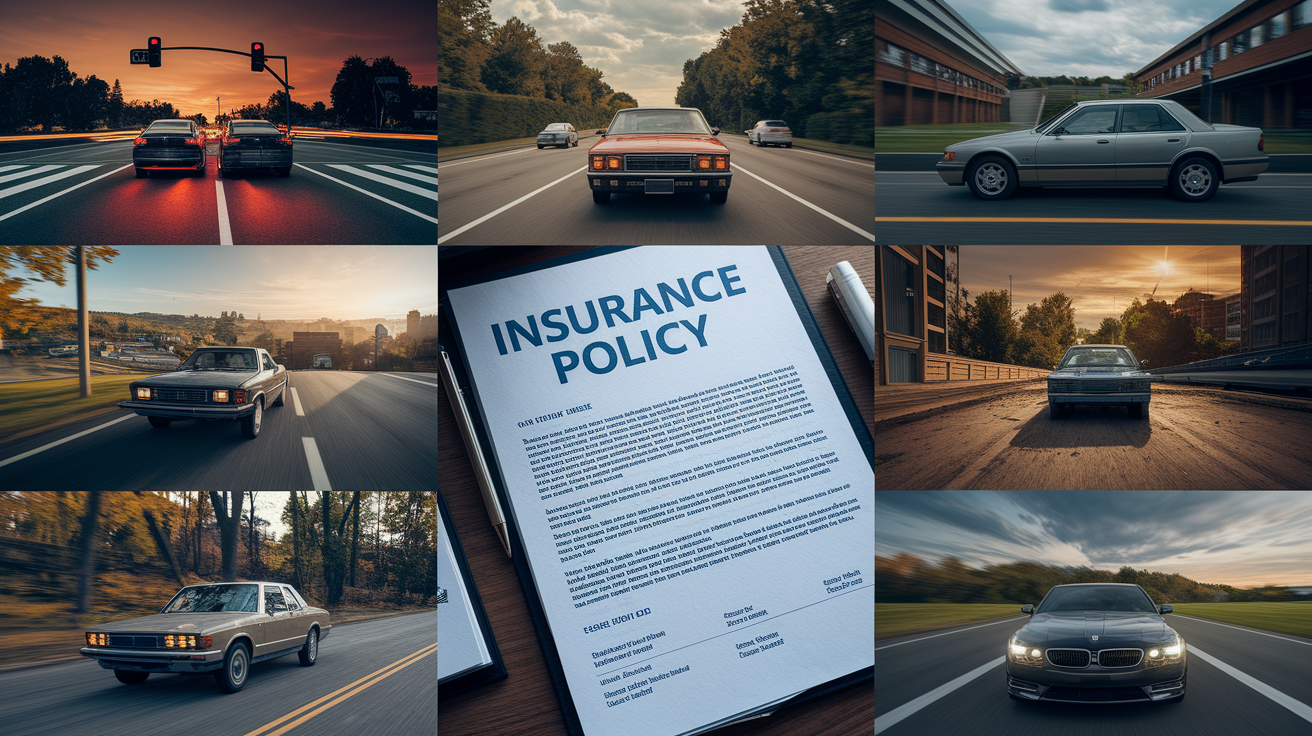
Looking at specific situations makes it easier to remember which coverage does what. The rule is simple. If you hit something or roll over, it’s collision. If something happens to your parked or moving car that isn’t a crash, it’s comprehensive.
Six real world examples with dollar figures:
-
Collision: rear-end crash. You’re stopped at a red light and the car behind you doesn’t brake in time. Rear bumper and trunk damage costs $3,200 to fix. Your collision coverage handles it after you pay your $500 deductible, so the insurer pays $2,700.
-
Collision: single-car rollover. You swerve to avoid debris on the highway, lose control, and roll the vehicle. It’s totaled. Actual cash value is $11,000. With a $1,000 collision deductible, you get $10,000.
-
Collision: backing into a pole. Reversing out of a parking spot, you don’t see the light pole and dent the rear quarter panel. Repair is $1,800. Collision deductible is $1,000, so you pay $1,000 and get $800.
-
Comprehensive: car stolen. Thieves take your car overnight. It’s never recovered. Actual cash value is $14,000, comprehensive deductible is $500. You receive $13,500.
-
Comprehensive: hail damage. A severe hailstorm dents the hood, roof, and trunk. Body shop estimates $4,500 in paintless dent removal and panel work. Your $1,000 comprehensive deductible means you pay $1,000, insurer pays $3,500.
-
Comprehensive: windshield crack from road debris. A rock flies up and cracks your windshield. Replacement costs $450. If you have a glass endorsement with $0 deductible, you pay nothing. If your comprehensive deductible is $500, you’d pay the full $450 yourself (below the deductible, so no insurance payout).
These examples show why many people keep comprehensive even after dropping collision on older cars. Theft and weather don’t care how carefully you drive.
Cost Comparison of Comprehensive vs Collision Insurance

Adding collision and comprehensive to a liability only policy increases your annual premium by several hundred dollars. Exact amounts depend on your car’s value, your ZIP code, your age, and your driving record. Typical ranges give you a starting point for budgeting.
Comprehensive usually costs less than collision because claims tend to be smaller and less frequent. Most drivers experience more fender benders than total loss thefts or hailstorms. Collision covers higher risk, higher cost events tied directly to how and where you drive. That difference shows up in the premium split.
Deductible choice also moves the needle. Raising your deductible from $500 to $1,000 can drop your collision and comprehensive premiums by 10 to 30 percent. On a combined annual cost of $600, that’s a potential savings of $60 to $180 per year. The tradeoff is paying an extra $500 out of pocket when you file a claim, so the math works best if you don’t file claims often and can cover the higher deductible without stress.
| Coverage | Typical Annual Cost | Notes |
|---|---|---|
| Comprehensive | $100–$300 | Lower cost; covers theft, weather, vandalism |
| Collision | $300–$700 | Higher cost; covers crashes, rollovers |
| Combined total | $400–$1,000+ | Varies by vehicle value, location, driver record |
Requirements for Collision and Comprehensive Insurance

Collision and comprehensive are optional coverages under state law. Liability insurance is mandatory in almost every state, but you’re legally free to skip collision and comprehensive if you own your car outright and accept the risk of paying for repairs or replacement yourself.
Lenders and leasing companies change that calculation. If you finance a car or lease one, the lender typically requires both collision and comprehensive until the loan is paid off or the lease ends. The requirement protects the lender’s investment. If the car is totaled and you have no coverage, the lender loses the collateral securing the loan. Your loan or lease contract will spell out the required coverages and often set a maximum deductible, commonly $1,000 or $1,500.
Drop required coverage or let your policy lapse? The lender can add force placed insurance to your loan. Force placed coverage is expensive, sometimes two to three times the cost of a normal policy. It only protects the lender’s interest, not yours. You still owe the loan payments, and you’re stuck with a much higher insurance bill until you buy your own policy again and prove it to the lender.
Deciding Whether You Need Comprehensive, Collision, or Both
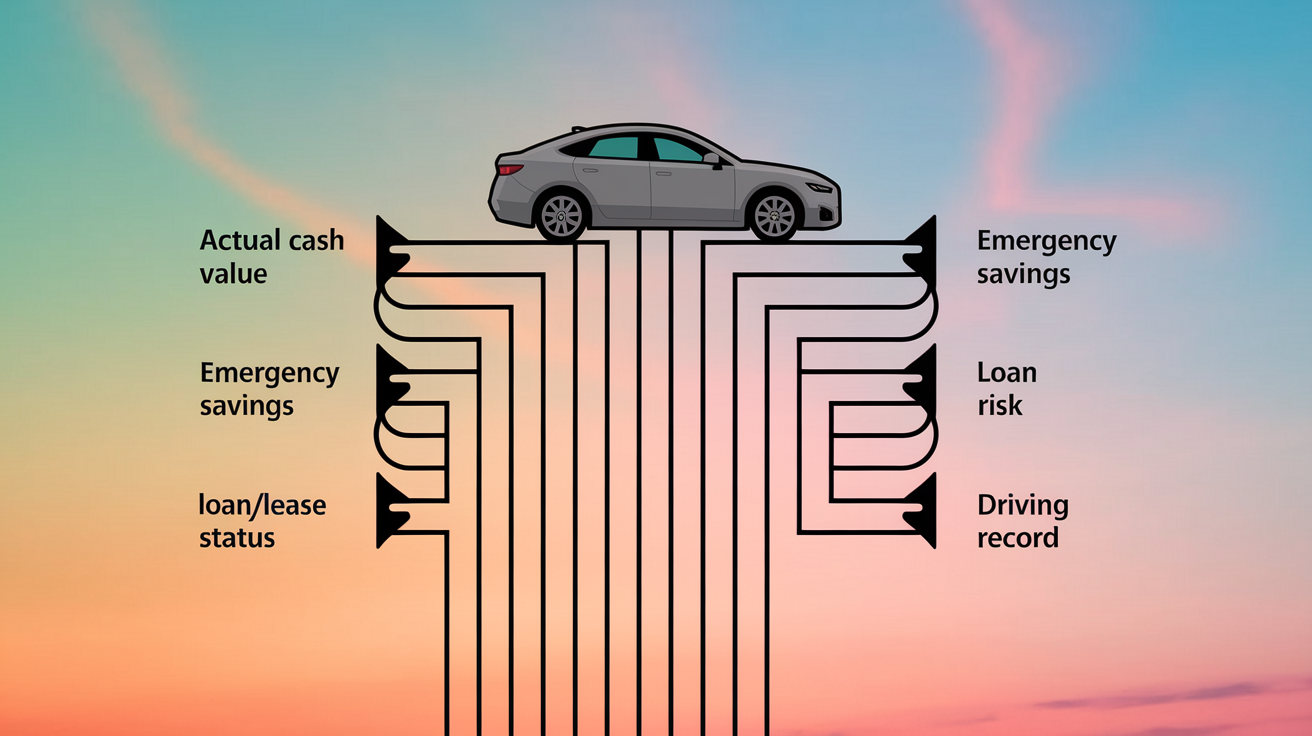
The decision comes down to three things. What you’re required to carry, what your car is worth, and whether you can afford to replace it out of pocket if something happens tomorrow.
If the car is financed or leased, keep both until the loan is satisfied. After that, the math depends on the vehicle’s actual cash value and how much you’re paying in premiums. A common rule of thumb: consider dropping collision when the car’s value is less than or equal to your deductible plus two to three times your annual collision premium. For example, if your collision premium is $400 per year and your deductible is $1,000, the threshold is roughly $1,800 to $2,200. Car’s worth $5,000? Collision still makes sense. Worth $2,000? You’re paying a lot relative to the maximum payout you’d ever see.
Five decision factors to weigh right now:
- Vehicle actual cash value. Check recent sales of similar make, model, year, and mileage in your area.
- Emergency savings. Can you cover the deductible plus the gap between a total loss payout and replacement cost without financial stress?
- Loan or lease status. Required coverage overrides all other factors.
- Local risk. High theft or severe weather areas raise the value of comprehensive. High traffic or icy road areas raise the value of collision.
- Driving record and habits. Frequent at-fault accidents make collision more valuable. Clean record and defensive driving lower the expected payout.
Many drivers keep comprehensive even after dropping collision because comprehensive premiums are lower and theft or hail can happen no matter how carefully you drive. If you live in an area with frequent severe weather or high vehicle theft rates and your comprehensive premium is only $150 per year, it’s often worth keeping for the peace of mind, even on an older car worth $4,000.
How Filing a Claim Affects Your Insurance Costs

Filing a claim under collision or comprehensive can raise your premium at the next renewal. How much and for how long depends on the type of claim, your insurer’s rules, your state’s regulations, and your claims history.
Collision claims, especially at-fault accidents, typically trigger larger surcharges because they signal higher risk. You rear-end someone or roll your car? The insurer sees you as more likely to file another expensive claim. Comprehensive claims tied to theft, weather, or hitting an animal usually result in smaller increases or no increase at all. The insurer views those as random bad luck rather than driver behavior. Glass only comprehensive claims sometimes have no rate impact, particularly if your policy includes a separate glass coverage endorsement.
Surcharges usually stay on your policy for three to five years, though some states cap the duration or limit how much insurers can raise rates after a single claim. The size of the surcharge depends on three factors:
- Claim severity. A $15,000 total loss claim raises rates more than a $1,500 fender repair.
- Fault and frequency. At-fault collision claims and multiple claims in a short period create the largest increases.
- State and insurer rules. Some states prohibit surcharges for certain comprehensive claims. Some insurers offer accident forgiveness that waives the first at-fault increase.
Filing Comprehensive vs Collision Claims: Step‑by‑Step Guide

The claim process is similar for both coverages, but the documentation requirements differ slightly depending on what happened. Insurance companies need proof of the damage, its cause, and its cost before they’ll issue a payout.
Here’s how to file either type of claim from start to finish:
-
Contact your insurer immediately. Call the claims hotline or file online through the app as soon as it’s safe to do so. For theft, call the police first, then your insurer. For collisions, exchange information with the other driver and call your insurer within 24 hours.
-
Document the damage with photos. Take pictures of all damaged areas, the overall vehicle, the scene (if it’s a collision), and any objects involved (the pole you hit, the tree branch that fell). For comprehensive claims like theft, photograph where the car was parked and any broken glass or pry marks.
-
File a police report if required. Theft, hit and run, and vandalism usually require a police report. Your insurer will ask for the report number and may request a copy. Collision claims without another party involved typically don’t need a police report unless local law requires one.
-
Get repair estimates. Your insurer may send an appraiser or ask you to get estimates from approved shops. For comprehensive claims, especially hail or glass damage, the insurer often works directly with a network shop. You can choose your own repairer, but using a network shop may speed things up.
-
Agree on actual cash value for total losses. If the car is totaled, the insurer will determine its actual cash value based on recent sales of comparable vehicles. You can negotiate if you believe the valuation is too low. Provide listings and sales data to support your case.
-
Pay your deductible. The shop may collect the deductible directly, or the insurer will subtract it from the payout check. Repairs cost $3,000 and your deductible is $500? The insurer writes a check for $2,500.
-
Receive payout and close the claim. For repairs, the shop gets paid directly or you get reimbursed after paying the shop. For total losses, you receive a check for the actual cash value minus your deductible. The insurer will ask you to sign over the title if they’re taking possession of the totaled vehicle.
Final Words
Collision pays for crashes, like hitting another car, a guardrail, or rolling over. Comprehensive covers non-crash losses such as theft, hail, fire, falling trees, or animal strikes.
Deductibles (commonly $250 to $1,000) get taken from payouts. Quick rule: drop collision when your car’s value is about the deductible plus 2–3 times the annual premium. Many keep comprehensive for theft or hail risk.
Check your car’s value and compare premiums. This is the comprehensive vs collision insurance explained guide—now you can choose with less stress.
FAQ
Q: Is it better to have collision or comprehensive?
A: Whether it’s better to have collision or comprehensive depends on the risk: collision covers crashes and rollovers, comprehensive covers theft, hail, fire, and animals. Lenders often require both; drop collision for low-value cars.
Q: Can you drive any car on comprehensive insurance?
A: Comprehensive insurance covers the specific vehicle listed on your policy, not any car you drive. To be covered in another car you need the owner’s insurance, permission, or a special endorsement on your policy.
Q: What is the average cost of comprehensive?
A: The average cost of comprehensive insurance is about $100–$300 per year. Your price depends on vehicle value, ZIP code, deductible, and claims history, so your premium may be higher or lower.
Q: Is it better to have a $500 deductible or $1 000?
A: Choosing a $500 or $1,000 deductible depends on cash you’d pay after a claim: $1,000 lowers premiums (about 10–30%) but raises out-of-pocket risk; pick higher only if you can afford the larger deductible.