

What if spending on small treats while you’re broke is actually the thing that helps you stay on track?
This post gives a simple, step-by-step way to find a safe discretionary (wants) amount, lock it in, and use it without shame.
Do the quick math, protect a tiny savings cushion, and set a clear weekly or monthly cap so you stop guessing and stop feeling guilty.
You’ll get short checklists, tracking tricks (cash envelopes or apps), and real budgets so the plan actually works.
Calculating Your Safe, Guilt‑Free Spending Amount

First thing you need is a real number. Not a guess, not a vague sense of “maybe I can spend a little this week.” An actual dollar amount you can spend on wants without tanking your bills or draining your safety net.
This takes maybe fifteen minutes. Grab a recent bank statement and a calculator.
Write down your monthly take‑home pay. The number that actually lands in your account after taxes and deductions. Then list every fixed expense: rent, utilities, phone, minimum debt payments, transportation, your core grocery estimate. Subtract those from your take‑home. Look at what’s left. From that remainder, set aside a small savings amount. Even if it’s just $25 or $50. Protecting Future You is part of what makes spending guilt‑free today. Finally, apply a safe percentage to what’s left for discretionary wants. If your budget’s tight, start with 5 to 10% of take‑home instead of the classic 30%. That small, protected amount becomes your guilt‑free cap.
Here’s the breakdown:
- Write down monthly net income (take‑home pay).
- List all fixed expenses (rent, utilities, minimum debt payments, transportation, basic groceries).
- Subtract fixed expenses from net income to find your flexible remainder.
- Set aside a small, realistic savings or debt‑paydown amount (even $25 to $50 counts).
- Apply 5 to 10% of your original take‑home to discretionary wants, or use what’s left after savings if that’s lower.
Once you’ve got a number (say $80, $120, or $200), you’ve turned vague anxiety into a controlled decision. You’re not guessing or hoping you won’t overdraw. You know the boundary. And spending inside it stops being something to apologize for.
Adapting the 50/30/20 Rule for Very Tight Budgets

The classic 50/30/20 rule says put 50% toward needs, 30% toward wants, and 20% toward savings. Works fine if your income comfortably covers rent and groceries with room left over. But if you’re bringing home $1,800 a month and rent alone eats $900, that 30% wants category is a fantasy. The math doesn’t stretch. Trying to force it just makes you feel like you’re failing at budgeting.
Shift the percentages to match reality. A 70/20/10 split (70% needs, 20% wants, 10% savings) is more honest when essentials are heavy. For even tighter months, try 80/10/10: 80% needs, 10% wants, 10% savings. The key is keeping a small, protected discretionary slice even when money’s lean. That 10% isn’t frivolous. It’s the release valve that keeps you from snapping and blowing the budget in frustration.
Here’s what that looks like in practice. If you take home $1,800 per month and use 80/10/10, essentials get $1,440, wants get $180, and savings gets $180. That $180 for wants breaks down to roughly $42 per week or $6 per day. A coffee, a thrift‑store book, a small treat that makes the week bearable. At $2,200 monthly income with 70/20/10, needs take $1,540, wants get $440, and savings gets $220. Now you’ve got $100 per week for discretionary spending. Enough for a Friday dinner out or a small hobby expense. The percentages aren’t rigid. The point is to name a realistic number and protect it, so spending stops feeling like theft from your future.
Psychology of Guilt‑Free Spending

Money guilt for low‑income earners usually comes from one place: the fear that any dollar spent on enjoyment is a dollar that should’ve gone to something more urgent. That fear isn’t irrational. It’s grounded in real risk. But when it runs unchecked, it creates a cycle where you restrict everything, feel deprived, and then impulse‑spend in rebellion. The guilt comes back harder. The loop repeats.
Predetermined “permission budgets” break that cycle. When you’ve already calculated a safe discretionary amount and funded it in advance, spending becomes a planned behavior instead of a moral failure. You’re not sneaking money from the grocery fund or hoping the electric bill doesn’t bounce. You’re using dollars you deliberately set aside for this exact purpose. That shift (from “I shouldn’t be doing this” to “I planned for this”) cuts guilt at the root.
Reframe wants as part of sustainability, not obstacles to it. A $15 book, a $10 streaming subscription, or a $25 dinner out aren’t sabotaging your financial health if they’re inside your discretionary cap and they help you stay engaged with a tight budget for months at a time. Think of discretionary spending the way you’d think of rest days in a training plan: small releases that keep the whole system functional. You’re not choosing between responsibility and enjoyment. You’re choosing a balanced plan that includes both, in realistic proportions.
Tools and Methods for Tracking Discretionary Spending
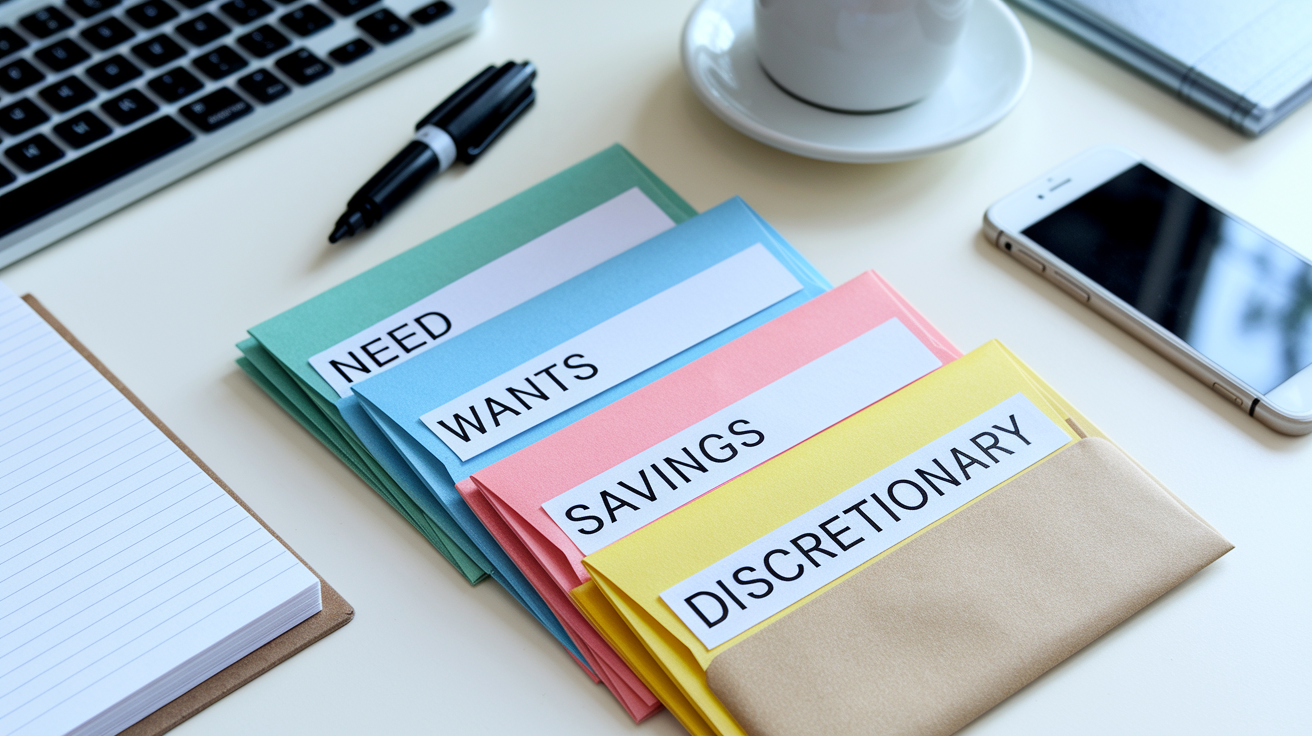
Tracking discretionary spending doesn’t require fancy software. The goal is simple: know how much you’ve spent in your guilt‑free category and stop when you hit the limit. Manual methods work as well as apps, and sometimes better, because the physical act of counting cash or marking a list makes the boundary more tangible.
If you prefer digital tools, look for budgeting apps that let you create separate spending categories and set weekly or monthly caps with alerts. Many apps will notify you when you’re close to your discretionary limit, which helps if you tend to lose track mid‑month. If you prefer manual systems, they’re just as effective and often clearer. Cash envelopes and weekly caps force real‑time decisions without the delay of syncing bank transactions. Pick the method that matches how you naturally pay attention to money. Don’t force yourself into a system that feels like homework.
Four practical tracking systems:
Cash envelopes: Withdraw your monthly discretionary amount in cash and divide it into weekly envelopes. Once the envelope is empty, you’re done spending that week.
Weekly spending caps: Set a fixed weekly amount (like $40/week) and reset every Monday. Track purchases on a small notepad or your phone’s notes app.
No‑rollover method: Spend only what’s budgeted for the current week. Unspent money goes to savings or next month’s buffer, not this week’s splurge.
Category‑based alerts: Use a banking app or spreadsheet to tag discretionary purchases by type (coffee, takeout, entertainment) and set alerts when any category hits 75% of its monthly cap.
Realistic Examples of Guilt‑Free Spending on a Tight Budget

Seeing real numbers makes the system feel possible. The examples below show three different income levels, each with a realistic breakdown of essentials, savings, and guilt‑free discretionary spending. These aren’t aspirational budgets. They’re grounded in what low‑income households actually manage.
The budgets assume you’ve already calculated your safe discretionary percentage using the steps earlier. Notice how even the tightest example protects a small wants category. That’s intentional. Sustainability matters more than perfection, and a $10‑per‑week discretionary cushion prevents the kind of burnout that leads to bigger, unplanned spending later.
| Income | Essential Costs | Savings | Discretionary Amount | Example Wants |
|---|---|---|---|---|
| $1,600/mo | $1,280 (80%) | $160 (10%) | $160 (10%) | $40/week: one Friday takeout ($15), two coffees ($8), one thrift store find ($10), small buffer ($7) |
| $2,000/mo | $1,400 (70%) | $200 (10%) | $400 (20%) | $100/week: two dinners out ($50), streaming subscription ($15), hobby supplies ($20), misc treats ($15) |
| $2,400/mo | $1,680 (70%) | $240 (10%) | $480 (20%) | $120/week: weekend entertainment ($40), three coffee dates ($18), one monthly larger purchase like concert tickets or new shoes (saved $40/week = $160/month) |
Each example includes a mix of frequent small purchases and occasional larger ones. The $1,600 budget shows how even $40 per week creates breathing room. The $2,000 and $2,400 budgets show how a 20% discretionary slice supports regular social spending and small hobbies without threatening essentials. All three protect a 10% savings rate, proving that guilt‑free spending and financial progress can coexist when the system is clear and the numbers are realistic.
Final Words
Start spending with a plan: calculate your safe amount, follow the five-step method, and tweak the 50/30/20 rule to fit your income. Nail the permission budget so wants feel like choices, not mistakes.
Pick a tracking method—envelopes, weekly caps, or an app—and try the sample budgets to see what works. Check weekly and adjust; small fixes beat big regrets.
This post is a clear, step-by-step guide to guilt-free discretionary spending on a tight budget, so you can enjoy treats without blowing your bills.
FAQ
Q: What is the 3 6 9 rule of money?
A: The 3 6 9 rule of money is a layered emergency-fund guideline: aim for three months’ essentials as a minimum, six months for solid coverage, and nine months if your income is unstable.
Q: What is the 70-10-10-10 budget rule?
A: The 70-10-10-10 budget rule splits income into 70% for essentials, 10% for savings, 10% for debt or retirement, and 10% reserved for guilt-free discretionary spending.
Q: What is the $27.40 rule?
A: The $27.40 rule is a small-dollar discretionary guideline many use: set aside about $27.40 weekly (roughly $110/month) for guilt-free spending so bills and savings stay protected.
Q: What is the 3 3 3 rule for savings?
A: The 3 3 3 rule for savings is a staged emergency plan: start with a tiny starter cushion, then build to three months’ essential expenses and keep that three-month buffer maintained.