
What if your business looks profitable but can’t pay the bills?
Cash flow highlights show whether money actually moved through your bank account, not just what you invoiced on paper.
Start with operating cash flow (money from daily sales minus day-to-day bills).
This post walks you through five quick signs, operating cash flow, ending cash trend, investing outflows, financing moves, and working capital shifts, so you can spot trouble fast and know the first steps to take.
Immediate Guidance for Reading Cash Flow Highlights in Small Businesses

Cash flow highlights show you whether your business actually has the money it needs to operate. Start with operating cash flow. That’s the cash moving through your day-to-day work, like customer payments coming in and supplier bills going out. Positive operating cash flow means your core business is generating money. Negative operating cash flow? That’s a red flag. Customers aren’t paying on time, you’re spending too much, or your pricing doesn’t cover your bills.
Everything else matters, equipment purchases, loan proceeds, all of it. But operating cash flow tells you if the business model actually works.
Profit and cash flow aren’t the same thing. Your income statement might show $12,000 profit for the month because you invoiced $20,000 and your expenses totaled $8,000. But if you only collected $5,000 of that $20,000 in actual payments, your operating cash flow is negative $3,000. The difference comes down to timing and working capital. Profit is based on what you billed and what you owe. Cash flow is based on what moved through your bank account. Cash flow highlights always show what happened to your actual money.
When you open a cash flow statement, look for these five things first:
Operating cash flow sign and size. Is it positive or negative, and how does it compare to net income?
Ending cash balance trend. Is your cash position growing, holding steady, or dropping month over month?
Investing outflows. Did you buy equipment or property? If so, did you plan for it?
Financing inflows or outflows. Did you take new loans or pay down debt, and how often is this happening?
Working capital movements. Are accounts receivable rising faster than revenue? Are payables stretching too long?
Key Cash Flow Statement Components Small Businesses Must Understand

Every cash flow statement divides your cash movements into three categories. Operating activities include cash receipts from customers, payments to suppliers and employees, interest paid, and income taxes paid. Investing activities cover purchases or sales of long-term assets like equipment, vehicles, or property, plus any loans you make to others or investments in securities. Financing activities track cash from loans, repayments, equity investments, dividends paid, or share repurchases.
Each category answers a different question. Is the business generating cash on its own? Are you reinvesting in growth? Are you relying on outside money?
These three sections work together to show you where cash came from and where it went. A small business with strong operating cash flow and negative investing cash flow is usually healthy. It’s funding growth from operations and putting cash into assets. A business with negative operating cash flow and repeated positive financing cash flow may be covering operational shortfalls with loans. That’s not sustainable. The net result of all three sections is your net change in cash, which you add to your starting cash balance to get your ending cash balance. That ending number is the real liquidity you have on hand.
| Activity Type | Common Examples | Interpretation Notes |
|---|---|---|
| Operating | Customer payments; supplier bills; payroll; interest; taxes | Positive = business generates cash from operations; negative = cash drain from core activities |
| Investing | Equipment purchase; vehicle sale; property acquisition; securities | Negative usually means reinvestment in growth; positive may signal asset liquidation |
| Financing | Loan proceeds; loan repayments; equity investments; dividends paid | Positive = new borrowing or capital; negative = paying down debt or returning capital |
Practical Interpretation of Operating Cash Flow Trends
Operating cash flow starts with your net income from the income statement, then adjusts for items that affected profit but didn’t move cash and for changes in working capital. Depreciation is a common example. It reduces net income on your books, but no cash leaves the account, so you add it back.
Changes in accounts receivable, inventory, and accounts payable all shift operating cash flow. If you invoice $20,000 but collect only $5,000, your accounts receivable go up $15,000, and you subtract that increase from operating cash flow. If your payables increase by $7,000 because you delayed supplier payments, you add that to operating cash flow for now. You’ll pay it later, though.
Positive operating cash flow is a strong signal that your business model is working. Your customers are paying, your pricing covers your expenses, and you’re generating cash from your daily work. Negative operating cash flow can come from several causes. Customers paying slowly, inventory buildup ahead of a busy season, or spending more than you’re bringing in. Context matters. A one-month dip during a seasonal lull may be fine. Three or four consecutive months of negative operating cash flow with no clear growth investment? That’s a warning sign. You need to fix pricing, collections, or spending.
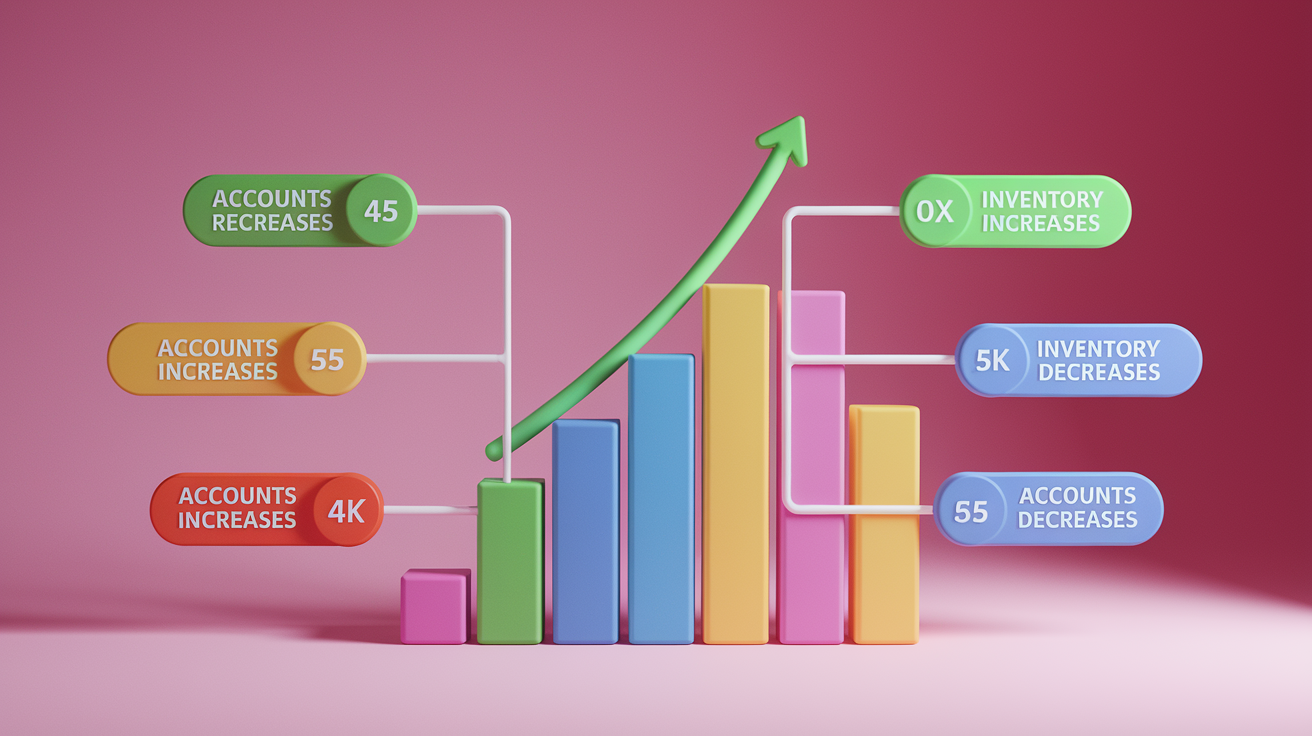
Six working capital drivers influence operating cash flow every month:
Accounts receivable increases subtract from operating cash flow. You invoiced but didn’t collect yet.
Accounts receivable decreases add to operating cash flow. You collected outstanding invoices.
Inventory increases subtract from operating cash flow. You bought stock but haven’t sold it yet.
Inventory decreases add to operating cash flow. You sold inventory and converted it to cash.
Accounts payable increases add to operating cash flow. You received goods but haven’t paid yet.
Accounts payable decreases subtract from operating cash flow. You paid down supplier bills.
Understanding Investing and Financing Cash Flow Highlights

Investing cash flow shows money moving in and out for long-term assets. When you buy a new delivery van for $25,000 in cash, that’s a $25,000 outflow under investing activities. When you sell old equipment for $2,000, that’s a $2,000 inflow. Negative investing cash flow isn’t automatically bad. It often means you’re reinvesting in the business, buying tools, technology, or property that will help you grow.
Positive investing cash flow can be healthy if you’re selling unneeded assets. But if it becomes a pattern and you’re liquidating assets to raise cash, that’s a warning. Operations aren’t funding the business.
Financing cash flow tracks money from lenders and investors. A $100,000 loan shows up as a positive financing cash flow. Paying down $20,000 of that loan is a negative financing cash flow. Raising equity from an investor or partner is positive. Paying dividends or distributions is negative.
The key rule is sustainability. If your operating cash flow is consistently negative and you’re covering the gap with loans or equity every few months, you’re not solving the underlying problem. Eventually, lenders stop lending and investors stop investing. Financing should support planned growth or bridge short-term gaps, not replace broken operations.
Four interpretation rules for investing and financing highlights:
Negative investing cash flow paired with positive operating cash flow equals a healthy reinvestment cycle. The business funds its own growth.
Negative investing cash flow paired with negative operating cash flow means potential overinvestment or mistimed capital spending. Review whether the asset purchase is essential.
Positive financing cash flow appearing regularly signals reliance on external funding. Check whether operating cash flow is improving or if this is masking a cash generation problem.
Negative financing cash flow with stable operating cash flow means debt paydown or capital return. Usually a sign of financial strength if operations remain positive.
Comparing Profit vs Cash Flow for Better Financial Decisions

Profit is an accounting measure built on accrual rules. You record revenue when you invoice, not when you collect. You record expenses when incurred, not when paid. That creates a gap between reported profit and actual cash.
A real example: a small business reported $75,000 in net income one month but ended the month with only $31,000 in cash. The difference came from invoicing customers who hadn’t paid yet, inventory purchases, and non-cash expenses like depreciation that reduced profit but didn’t touch the bank account.
Cash flow removes that accounting noise. It shows only the transactions that moved money in or out. If you want to know whether you can pay your rent, hire another employee, or invest in new equipment, look at cash flow. If you want to know whether your business model is profitable on paper, look at net income.
Both matter. But cash flow answers the urgent question: do you have the money right now? Profit answers the strategic question: are you pricing and operating in a way that should eventually generate cash?
Four non-cash adjustments that commonly distort profit:
Depreciation spreads the cost of equipment over several years. Reduces profit but is not a cash payment each month.
Amortization is similar to depreciation, applied to intangible assets like software licenses or trademarks.
Accounts receivable changes mean revenue recorded when invoiced, cash recorded when collected. Timing mismatch.
Inventory valuation means cost recorded when inventory is purchased, revenue recorded when sold. Profit lags or leads cash depending on payment timing.
Identifying Cash Flow Red Flags in Small Businesses

Persistent negative operating cash flow is the first red flag. One or two months can happen during seasonal swings or when you make a big inventory buy ahead of busy season. Six months in a row means your core operations aren’t generating cash. You need to investigate pricing, collections, or cost structure.
Rising accounts receivable is the second warning sign. If your invoiced revenue is growing but your cash collections aren’t keeping pace, customers are taking longer to pay. You’re funding their purchases with your own working capital.
Cash burn rate measures how much cash you lose each month when operating cash flow is negative. If you’re burning $30,000 a month and you have $300,000 in the bank, your runway is ten months. After that, you’re out of cash unless something changes.
Days sales outstanding (DSO) tells you how many days, on average, it takes to collect an invoice. If DSO climbs from 30 days to 60 days, you have a collections problem. Days payable outstanding (DPO) measures how long you take to pay suppliers. If DPO drops suddenly, you may be paying bills faster than planned, which drains cash. If DPO rises too high, you risk damaging supplier relationships or incurring late fees.
Six measurable red flags to watch:
Three or more consecutive months of negative operating cash flow with no clear seasonal or growth explanation.
Accounts receivable growing faster than revenue indicates customers are delaying payment or your credit terms are too loose.
Declining cash balance despite reported profit means profit isn’t converting to cash. Review working capital and non-cash adjustments.
Repeated positive cash flow from financing with flat or negative operating cash flow signals reliance on loans or equity to cover operational shortfalls.
Large one-time asset sales propping up cash balance is a temporary fix that hides underlying cash generation problems.
Rising inventory levels with stagnant or falling sales means cash is tied up in unsold stock, reducing liquidity.
Using Cash Flow Highlights for Forecasting and Short-Term Planning

Cash flow highlights feed directly into your short-term planning. A rolling 13-week cash forecast uses recent trends to project cash inflows and outflows week by week for the next quarter. You start with your current cash balance, add expected customer payments, subtract planned supplier bills, payroll, loan payments, and any planned equipment purchases. The forecast shows you when cash will dip below a safe threshold, giving you time to delay a purchase, accelerate collections, or arrange a short-term loan.
Scenario planning reveals what happens if assumptions change. Build a base forecast assuming customers pay on time. Then build a second scenario where 30 percent of invoices are delayed by two weeks. Compare the two forecasts to see how much runway you lose and when you need to act.
Many small businesses review cash flow monthly. But if you’re tight on cash or in a growth phase, weekly reviews catch problems faster. Update your forecast with actual results each week so you’re always looking ahead with current data.
| Forecast Scenario | Key Assumption | Cash Flow Impact |
|---|---|---|
| Base Case | All invoices collected within 30 days; no delays | Ending cash balance $45,000 in week 13 |
| Delayed Collections | 30% of invoices delayed by 2 weeks | Ending cash balance drops to $18,000; triggers low-cash alert |
| Equipment Purchase Deferred | Delay $15,000 equipment buy from week 6 to week 14 | Ending cash balance rises to $33,000; preserves runway during tight period |
Tools and Techniques to Improve Cash Flow Highlights Interpretation

Accounting software automates cash flow reporting and eliminates manual calculation errors. QuickBooks and Xero both generate cash flow statements from your transaction data, breaking out operating, investing, and financing activities automatically. You can set the reporting period to monthly, quarterly, or custom ranges, and export statements for review or sharing with advisors.
Automated invoicing inside these platforms speeds up collections by sending invoices immediately after work is complete and setting up automatic payment reminders for overdue accounts.
Dashboards visualize cash flow trends over time. You can see a line chart of your ending cash balance each month, bar charts comparing operating cash flow to net income, and aging reports that highlight which customers owe money and for how long.
Monthly reviews are the minimum recommended cadence for small businesses. If cash is tight or you’re in rapid growth, review weekly and update your 13-week forecast every Monday. Larger businesses with high transaction volumes often review daily, but most small businesses find weekly or monthly reviews catch issues early enough to respond.
Five recommended tools and practices for better cash flow interpretation:
Use QuickBooks, Xero, or similar software to auto-generate monthly cash flow statements and eliminate manual reconciliation errors.
Turn on automated invoicing and payment reminders to reduce accounts receivable aging and speed up collections.
Build a rolling 13-week cash forecast in a spreadsheet or planning tool and update it weekly with actual results.
Set low-cash alerts at a threshold that gives you two to four weeks to respond. For example, alert when cash drops below $20,000 if your monthly burn is $15,000.
Compare cash flow highlights to prior months and to budget every review cycle. Look for variances in operating cash flow, DSO, and DPO. Investigate causes immediately.
Final Words
Start by scanning operating cash flow, then flip to investing and financing to spot one-offs and funding moves. Check profit versus cash so accounting items like depreciation don’t fool you.
Watch the usual red flags, rising receivables, shrinking balances, or heavy reliance on loans, and build a short rolling forecast you review weekly or monthly.
Interpreting cash flow highlights for small businesses is mostly about spotting trends, fixing small problems early, and acting. Do that regularly and you’ll be in much better shape.
FAQ
Q: What are cash flow highlights and how do I read them?
A: Cash flow highlights are the quick view of actual cash coming in and going out, split by operating, investing, and financing activities; read operating cash first to judge core performance, then overall net change.
Q: How does operating cash flow differ from profit?
A: Operating cash flow shows cash earned from daily business, while profit is accounting earnings that include noncash items (depreciation) and timing differences in invoices and collections.
Q: What are the three cash flow statement components I must know?
A: The three components are operating (customer receipts, supplier payments), investing (equipment buys/sales), and financing (loans, repayments, dividends); each shows different cash movement and strategic choices.
Q: What five quick indicators should I check first in cash flow highlights?
A: Check operating cash trend, change in cash balance, days sales outstanding (DSO), reliance on financing, and one-off asset sales masking operations.
Q: What operating cash flow trends should worry me?
A: Worry if operating cash is repeatedly negative, driven by rising receivables, inventory buildup, or timing gaps; depreciation can mask true cash needs, so adjust for noncash items when analyzing.
Q: How do investing and financing activities affect cash flow health?
A: Investing outflows often mean growth reinvestment; frequent financing inflows covering operations is risky; steady repayments or asset sales can signal cash stress versus planned capital moves.
Q: What noncash adjustments commonly make profit misleading?
A: Common noncash adjustments are depreciation, amortization, stock‑based compensation, and bad‑debt expense — they affect profit but not immediate cash available.
Q: What measurable cash flow red flags should I watch?
A: Watch rising DSO, falling days payable outstanding (DPO), repeated negative operating cash, shrinking cash balance, reliance on asset sales, and increasing monthly cash burn rate.
Q: How can I use cash flow highlights for short-term forecasting?
A: Use highlights to build a rolling 13‑week forecast, run scenarios for delayed payments or expenses, and review weekly or monthly to catch shortages early and adjust actions.
Q: What tools and practices improve cash flow interpretation?
A: Use accounting software (QuickBooks or Xero), automated invoicing, visual dashboards, monthly reviews, and a rolling forecast to spot trends and speed collections.